SOBHA Limited: Company Snapshot
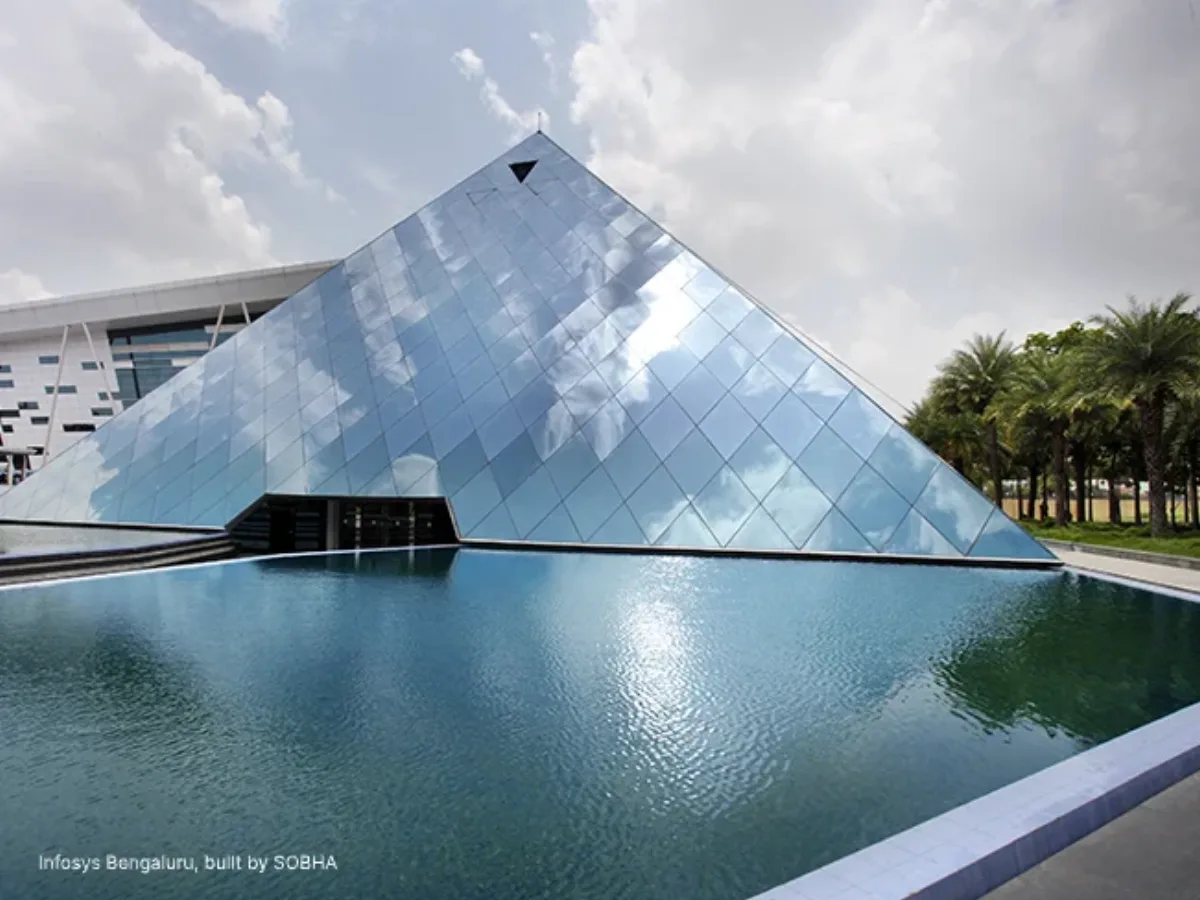
SOBHA Limited is among India's most recognised residential developers and holds the strongest build-quality reputation in the listed sector. Founded in 1995 by P.N.C. Menon, chaired by Ravi Menon and led by Managing Director Jagadish Nangineni, it is headquartered in Bengaluru and listed on the BSE and NSE.
The company has delivered approximately 148 million sq.ft across 600-plus projects in 27 Indian cities and the Middle East, with roughly 210 projects and 68 million sq.ft in Bengaluru alone — the largest premium-residential footprint in the city.
| Field | Detail |
|---|---|
| Legal name | SOBHA Limited |
| Founded | 1995 |
| Founder | P.N.C. Menon |
| Chairman | Ravi Menon |
| Managing Director | Jagadish Nangineni |
| Headquarters | Bengaluru, Karnataka |
| Listing | BSE / NSE, ticker SOBHA |
| CIN | L45201KA1995PLC018475 |
| Delivered | ~148 million sq.ft, 600+ projects |
| Presence | 27 Indian cities plus the Middle East |
| Bengaluru footprint | ~210 projects, ~68 million sq.ft |
| Certifications | ISO 9001:2015, ISO 14001:2015, OHSAS 18001 |
| Buyer rating | 4.9 / 5 (444 reviews) |
| Verticals | Residential, contracting and manufacturing, Middle East operations |
Backward Integration: What Actually Distinguishes SOBHA
Most developer reputations rest on marketing. SOBHA's rests on a structural fact about how the company is organised, and it is worth understanding properly because it is the entire justification for the price premium.
Most developers assemble a project from subcontractors. One firm builds the structure, another supplies and installs glazing, another fabricates joinery, another does metalwork, another handles finishes. The developer coordinates. Quality depends on each vendor's standards, on how well the coordination works, and on whether vendors change between phases as prices shift.
SOBHA manufactures. The company maintains in-house design, contracting and manufacturing capability, producing its own glazing — windows and glass systems; joinery — doors, windows, wardrobes and cabinetry; metalwork — railings, balustrades, grilles and fixings; and concrete, with its own production and control. It also carries a contracting arm that builds for third parties, which means its construction capability is a business in its own right rather than an internal cost centre.
What this produces that you can observe. Joinery tolerances: in-house manufactured doors and wardrobes show tighter, more consistent alignment than site-fabricated or bought-in equivalents, and doors that still close properly after five years are a joinery-quality outcome. Glazing performance: better-sealed windows with consistent frame finish, which matters directly for noise, dust and monsoon water ingress. Concrete and surface finish: straighter walls, more even surfaces, cleaner junctions where materials meet. Consistency between projects: a SOBHA apartment in one project closely resembles a SOBHA apartment in another, which is unusual in Indian residential and is a direct consequence of not depending on a rotating vendor base. And schedule reliability, with fewer dependencies on third-party availability and pricing.
Why it matters especially on a 40-acre phased project. The Hennur–Bagalur development will be built in phases across several years. On phased projects, developers dependent on external suppliers frequently find that Phase 4 finishes differ visibly from Phase 1 as vendors, specifications and prices change over the build period. In-house manufacturing makes consistency across a multi-year, multi-phase build far more achievable. On a development of this shape, that is a specific and material advantage rather than a general reputational one.
Financial Standing and the Realisation Figure
| Metric | FY26 | Change |
|---|---|---|
| Sales value | ₹8,136 crore — highest ever | +30% YoY |
| Revenue | ₹5,383.8 crore | +29.33% |
| Net profit | ₹193 crore | +104% |
| New sales area | 5.54 million sq.ft | +19% (FY25: 4.68 msf) |
| Bengaluru share of sales value | 55% | — |
| 9M FY26 average realisation | ~₹14,486 / sq.ft | — |
FY26 was SOBHA's strongest year on record. Bengaluru contributing 55% of sales value confirms this remains SOBHA's core market rather than a legacy one — relevant when assessing how much attention a Bengaluru project receives.
Read the quarters honestly. Within FY26 the results were lumpy: Q3 saw net profit slip to ₹15 crore on revenue down 22%, before a Q4 with profit up 125%. This pattern is normal in real estate, where revenue recognition follows construction milestones and project completions rather than accruing evenly. The full-year picture is strong; the quarter-to-quarter one is uneven, and a buyer reading a single quarter's headline could reach the wrong conclusion in either direction.
On the realisation figure and what it means for this project: SOBHA's average realisation across the portfolio in 9M FY26 was approximately ₹14,486 per sq.ft, while the Hennur–Bagalur corridor averages around ₹7,000. SOBHA does not sell at corridor-average rates anywhere. The portfolio figure is weighted by premium South and Central Bengaluru inventory and Middle East operations, so a North Bangalore project will price below it — but well above the local benchmark. The reasonable expectation is ₹9,500 to ₹12,000 per sq.ft, and the backward-integration argument is what makes that defensible rather than merely aspirational.
The listed-company advantage. SOBHA files quarterly results with the exchanges and publishes audited annual accounts. For a buyer purchasing into a project that will complete around 2030, developer solvency across the construction period is the principal risk — and here it is a matter of public, audited record rather than inference. Most Indian residential developers are unlisted, and their financial health can only be guessed at from how many cranes are moving.
The Bengaluru Portfolio and the Contracting Arm
With approximately 210 projects and 68 million sq.ft delivered in Bengaluru, SOBHA has the city's largest premium-residential footprint. Its projects span apartments, villas, townships and plotted development across every major corridor. On the broader Hennur and North Bangalore belt specifically, SOBHA Victoria Park on Hennur Road is an established SOBHA community, with others across Yelahanka, Thanisandra and the airport corridor.
A note for searchers: results for SOBHA Hennur frequently return Victoria Park and other existing SOBHA projects. The 40-acre Chikkagubbi development described on this site is a separate, as-yet-unnamed and unlaunched project.
One element of SOBHA's structure is often overlooked and worth understanding, because it is unusual. Alongside its own residential development, SOBHA operates a contracting and manufacturing business that builds for third parties — corporate campuses, institutional buildings and commercial projects for external clients. This is not a marginal activity; it is a distinct revenue vertical.
Two consequences follow for a residential buyer. The construction capability is externally tested. A developer whose building arm only ever serves its own projects is judged on its own marketing. One that wins and delivers third-party contracts is judged by clients who had alternatives and specifications to enforce. That is a harder test, and passing it repeatedly is meaningful evidence. Capability persists through residential cycles. When residential demand softens, developers who rely on subcontractors lose their assembled teams and rebuild them later, usually with different people. A contracting business gives SOBHA reason and revenue to retain skilled trades, manufacturing capacity and site management through downturns — which is part of why finish consistency holds across decades and across 600-plus projects. For a project that will be built in phases across several years, continuity of capability is not an abstract virtue. It is what makes Phase 4 resemble Phase 1.
Certifications, Standards and How to Verify Them
| Certification | Scope |
|---|---|
| ISO 9001:2015 | Quality management |
| ISO 14001:2015 | Environmental management |
| OHSAS 18001 | Occupational health and safety |
These are operated as an integrated management system. The environmental certification is the one most relevant to a 40-acre development — it means water treatment, waste management and rainwater harvesting provisions should be specified and audited rather than aspirational. Ask for capacities in kilolitres and hold them against the sanctioned population.
To verify this developer independently: check the exchange filings, where quarterly results, annual reports and material disclosures are public on the BSE and NSE. Read the FY26 annual report for debt, cash flow, project pipeline and revenue recognition. Visit a delivered SOBHA project — this is the most valuable step available — and inspect joinery alignment, window operation and sealing, concrete and wall finish, railing fabrication, and common-area maintenance in a building that is five or ten years old, because backward integration either shows up there or it does not. Talk to residents at a delivered project about handover experience, snagging, and how the building has aged. Check K-RERA records for SOBHA's ongoing projects, including delivery performance against declared completion dates. And track quarterly results through construction, understanding that quarter-to-quarter variation is normal.
Why This Developer, For This Project
The case rests on four things. A build-quality reputation with a structural basis: backward integration is a verifiable fact about how SOBHA is organised, not a marketing claim, and it is the reason the finish quality is consistent across 148 million sq.ft. Consistency across a phased build: on a 40-acre development delivered over several years, in-house manufacturing is the best available protection against Phase 4 differing from Phase 1. Financial strength and public accountability: a record FY26, and audited quarterly disclosure through a four-to-eight-year construction period. And depth in this city: around 210 Bengaluru projects and 68 million sq.ft, so this developer is not learning the Bengaluru market on the buyers of this one.
Against that, weigh two honest caveats. The premium is real — expect ₹9,500 to ₹12,000 per sq.ft on a corridor averaging ₹7,000 — and you should satisfy yourself that the specific product justifies it rather than assuming the brand does. And quarterly results are lumpy, so read the annual picture rather than reacting to a single quarter.
Corporate details for the record: the legal entity is SOBHA Limited, headquartered in Bengaluru, Karnataka, listed on the BSE and NSE under the ticker SOBHA, founded by P.N.C. Menon, chaired by Ravi Menon and led by Managing Director Jagadish Nangineni.
SOBHA Limited — Frequently Asked Questions
Who is the developer of the Hennur–Bagalur project?
SOBHA Limited, founded in 1995 by P.N.C. Menon, chaired by Ravi Menon and led by Managing Director Jagadish Nangineni. It is headquartered in Bengaluru, listed on the BSE and NSE under, and has delivered approximately 148 million sq.ft across 600-plus projects in 27 Indian cities and the Middle East.
What is backward integration and why does it matter?
Most developers assemble a project from subcontractors — one firm for the structure, another for glazing, another for joinery. SOBHA maintains in-house design, contracting and manufacturing capability, producing its own glazing, joinery, metalwork and concrete. Quality control sits inside one organisation rather than being distributed across a supply chain, schedule risk is lower, and finish consistency across projects is unusually high.
Why does backward integration matter more on a phased 40-acre project?
Because the development will be built in phases across several years. Developers dependent on external suppliers frequently find that Phase 4 finishes differ visibly from Phase 1 as vendors, specifications and prices change over the build period. In-house manufacturing makes consistency across a multi-year, multi-phase build far more achievable — a specific advantage for a development of this shape.
What does SOBHA's contracting arm tell a residential buyer?
SOBHA operates a contracting and manufacturing business that builds corporate campuses and institutional buildings for third-party clients, as a distinct revenue vertical. That means its construction capability is externally tested by clients who had alternatives and specifications to enforce, and it gives the company reason and revenue to retain skilled trades and manufacturing capacity through residential downturns.
How large is SOBHA's Bengaluru footprint?
Approximately 210 projects and 68 million sq.ft delivered in Bengaluru — the city's largest premium-residential footprint — spanning apartments, villas, townships and plotted development across every major corridor. On the broader Hennur and North Bangalore belt, SOBHA Victoria Park on Hennur Road is an established community, separate from the unnamed Chikkagubbi development described here.
How should I verify this developer independently?
Check the BSE and NSE filings, where quarterly results, annual reports and material disclosures are public. Read the FY26 annual report for debt, cash flow and pipeline. Visit a delivered SOBHA project that is five or ten years old and inspect joinery alignment, window operation and sealing, concrete and wall finish, railing fabrication and common-area maintenance. Talk to residents about handover and snagging. Check K-RERA records for delivery performance.